Drop-in speedups for scientific toolkits, produced by autonomous research.
AutoZyme combines automated experiment search with expert review to rewrite the slow paths inside widely used scientific packages — without changing their public API. Every shipped patch clears a strict output-concordance gate.
By the numbers
Benchmarks at a glance
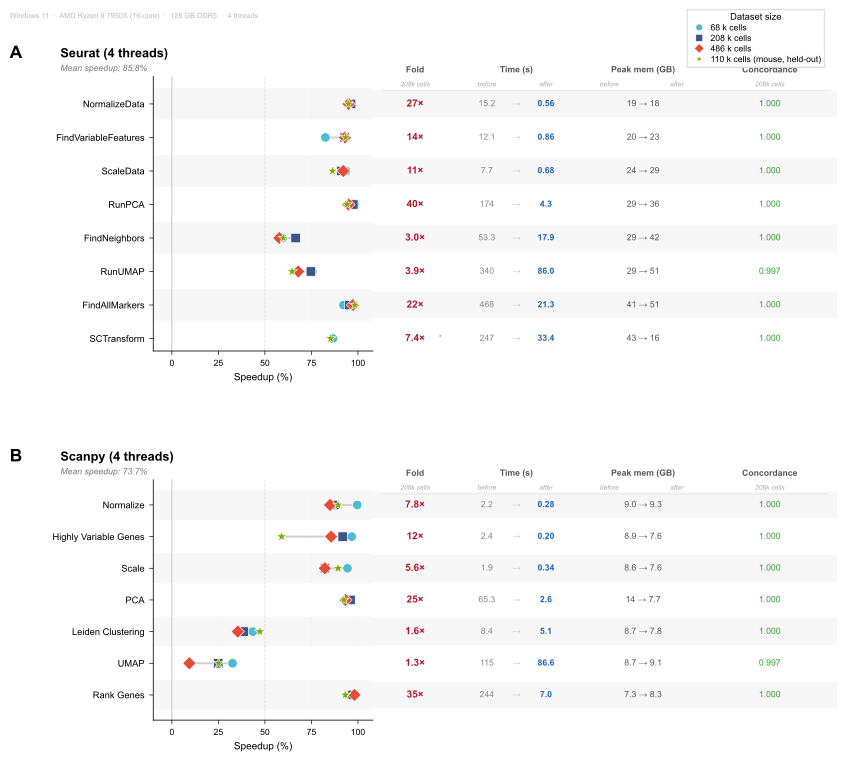
Top speedups
Install
# Install from GitHub (CRAN release coming)
remotes::install_github("ElliotXie/seurat-turbo")

library(Seurat)
library(SeuratTurbo)   # activates patches

# Use Seurat exactly as you normally would —
# NormalizeData / RunPCA / FindClusters / etc.
# are transparently accelerated.
# Install from GitHub (PyPI release coming)
pip install git+https://github.com/ElliotXie/scanpy-turbo.git

import scanpy as sc
import scanpy_turbo   # activates patches

# Use Scanpy exactly as you normally would —
# pp.normalize_total / tl.leiden / etc.
# are transparently accelerated.
Currently optimized
NormalizeData · FindVariableFeatures · ScaleData ·
RunPCA · FindNeighbors · FindClusters
(Louvain / Leiden) · RunUMAP · FindAllMarkers ·
SCTransform · IntegrateData (CCA)
normalize_total · highly_variable_genes · scale ·
pca · neighbors · leiden · umap ·
rank_genes_groups
How AutoZyme works
Under the hood, AutoZyme runs an autonomous research loop: candidate optimizations are generated, benchmarked against the upstream baseline on real datasets, and filtered on both speed and output concordance — ARI for clusterings, correlations for embeddings, Jaccard for marker lists, and so on. Only patches that preserve scientific output within tight tolerance are shipped.
You can nominate the next package for optimization on the Suggest & Vote page. We periodically review the top-voted entries and pick one to work on next.
How to cite
@misc{autozyme2026,
  title  = {AutoZyme: Autonomous-Research-Driven Speedups for Scientific Toolkits},
  author = {The AutoZyme Team},
  year   = {2026},
  note   = {Manuscript in preparation}
}